
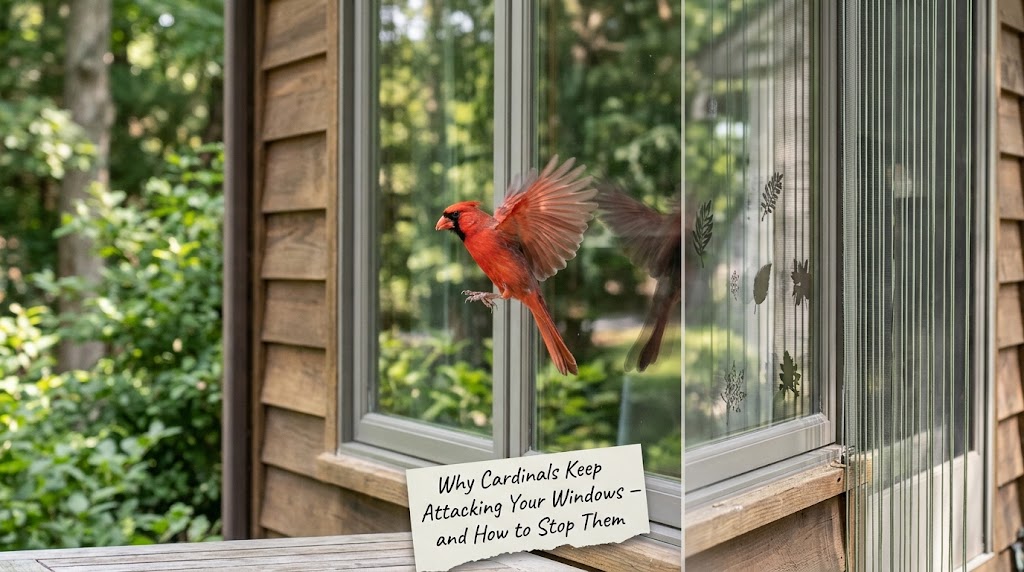
You hear it before you see it: a soft, rhythmic thud against the glass, over and over, sometimes for hours. If you’ve ever wondered why cardinals keep attacking your windows—and how to stop them, you’re not imagining things, and you’re definitely not alone. This is one of the most common bird-behavior questions homeowners ask every spring.
The Real Reason Behind the Behavior
Most people assume the bird is confused or hurt, but the truth is simpler. A cardinal sees its own reflection in your glass and mistakes it for a rival bird. It isn’t trying to break in or hurt itself on purpose; it’s defending territory from an “intruder” that happens to be its own mirror image. Understanding this is the first step toward answering why cardinals keep attacking your windows—and how to stop them, because the fix depends on removing the reflection, not the bird.
Cardinals are famously territorial, far more than many backyard species. Males in particular will chase off anything they perceive as competition, and a clear, reflective window during daylight creates a perfect illusion of a challenger. According to the Cornell Lab of Ornithology, this reflective-reaction behavior is well documented across several songbird species, not just cardinals, but cardinals tend to be especially persistent.
Why Cardinals Keep Attacking Your Windows During Mating Season
The timing matters. Spring and early summer line up with nesting season, when hormone levels rise and territorial instinct peaks. This is exactly why cardinals keep attacking your windows—and how to stop them becomes such a seasonal search: the problem often appears suddenly in March or April and fades by midsummer once nesting settles down. A pair guarding a nearby nest will treat any reflection near that territory as a threat worth repelling, sometimes dozens of times a day.
Female cardinals can display this behavior too, especially if they’re protecting eggs or chicks close to the house. So if you’ve noticed both a male and a female taking turns at the glass, that’s a strong sign there’s an active nest somewhere in your yard.
Where It Tends to Happen Most
Windows that face a garden, tree line, or anything resembling natural habitat are the most common targets. Reflective surfaces near feeders are especially problematic, since the bird is already spending time close to your home. Large, unbroken panes of glass create the clearest reflections, which is part of why cardinals keep attacking your windows—and how to stop them so often comes down to breaking up that reflection rather than chasing the bird away.
Car mirrors and polished metal can trigger the same reaction, but windows are the most frequent complaint simply because they’re large, common, and hard to avoid.
How to Stop Them: Fixes That Actually Work
The good news is that this behavior is very fixable once you understand the cause. The goal is always the same: eliminate the mirror effect, not punish or scare the bird long-term.
Covering the outside of the glass with a temporary film, soap streaks, or static clings breaks up the reflection enough that the cardinal no longer sees a rival. Hanging strips of fabric, ribbon, or even an old bedsheet a few inches in front of the window can work just as well while you figure out a permanent solution. Closing blinds or curtains during peak attack hours, usually early morning, also helps, since a dark window reflects far less light than an open, sunlit one.
Moving bird feeders further from the house reduces the number of cardinals spending time near your windows in the first place, which lowers the odds of any reflection conflict happening at all. If you already keep a feeder station, our guide to attracting backyard birds without creating window conflicts walks through smarter placement.
Products and Methods That Make a Lasting Difference
For a more permanent approach, specially designed window decals break up reflections using UV patterns visible to birds but barely noticeable to people. The American Bird Conservancy tests and recommends several of these products specifically for reducing window strikes and territorial attacks.
Applying a one-way film to the outside of the glass is another long-term fix; it keeps the view clear from inside while removing the mirror effect from outside. Netting hung a few inches from the glass works too, since it gives the bird something to bounce off harmlessly rather than hitting hard glass.
If you’ve already tried window treatments elsewhere in your home for other reasons, our piece on simple exterior upgrades that also help with bird strikes covers a few overlapping options worth reusing.
When to Call in Extra Help
Most cases resolve with a few weeks of consistent treatment, since the behavior usually fades once nesting season ends. But if a cardinal seems repeatedly injured, disoriented, or unable to stop even after you’ve covered the glass, it’s worth contacting a local wildlife rehabilitator rather than waiting it out. The Audubon Society maintains a directory of regional contacts if you need one.
Understanding why cardinals keep attacking your windows—and how to stop them isn’t about getting rid of a beautiful bird from your yard. It’s about removing a false signal that’s stressing the cardinal out as much as it’s stressing you out. A few small changes to your glass, and the thudding usually stops within days.